How to Choose the Right Leather Journal for Your Mission
Benjamin S. Fowler
Maker & Founder, Covenant Leather Co. · February 28, 2026 · 6 min read
I've been making leather journals for missionaries for years. I've also seen what happens to the ones that weren't made well — covers that peel, bindings that crack, pages that yellow after six months in a tropical climate.
Choosing the right journal for a mission is not complicated, but it requires knowing what to look for. Here is what I've learned.
Leather Type: The Most Important Decision
There are three tiers of leather used in journals, and they are not equal.
Full-Grain Leather — The Best
Full-grain leather is the outermost layer of the hide, with all the natural grain intact. It is the strongest, most durable, and most beautiful leather available. It develops a patina over time — darkening and softening with use. A full-grain leather journal carried for two years will look better at the end than it did at the beginning.
This is what we use for our flagship Covenant Journal.
Top-Grain Leather — Good
Top-grain leather is sanded to remove imperfections, then finished with a surface treatment. It is more uniform in appearance but slightly less durable than full-grain. Still a solid choice for a mission journal.
Bonded Leather — Avoid
Bonded leather is the particleboard of leather — scraps ground up and glued together with a polyurethane coating. It looks like leather when new. After six months of use, it begins to peel and crack. Do not buy a journal with bonded leather, especially for a mission.
How to tell the difference: Real leather smells like leather. It has a natural, slightly irregular surface. Bonded leather often has a too-perfect, plastic-looking grain and may smell slightly chemical.
Thread: Waxed Linen Over Everything
The stitching holds the journal together. Cheap thread — polyester or cotton — can rot, snap, or unravel in humid climates. Waxed linen thread is the traditional choice for leather goods because it is strong, water-resistant, and naturally antimicrobial.
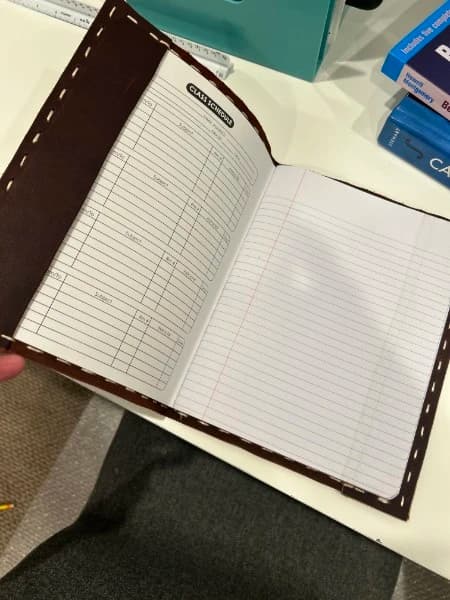
When you examine a leather journal, look at the stitching. Is it tight and even? Is the thread thick enough to feel substantial? Pull lightly at the corner — good saddle stitching will not give.
Paper: Acid-Free Is Non-Negotiable
Acid-free paper (pH 7 or above) will not yellow or become brittle over time. Regular paper contains acids that begin degrading within years. For a journal you intend to keep for decades, acid-free is essential.
Paper weight matters too. Thin paper (under 70gsm) will show ink bleed-through on both sides of the page. 80–100gsm paper allows for comfortable front-and-back use with most pens, including fountain pens.
Size: Pocket vs. Standard
This is a personal choice, but here's the guidance I give:
- Pocket size (4x6): Goes everywhere. Fits in a shirt pocket. Ideal for street contacting, companion study, quick notes. Fills up faster — you may need 2–3 during a mission.
- Standard size (5x8): More room to write. Better for extended journal entries and longer study notes. Fits in a bag. The most popular choice for daily journaling.
- Large size (8x10): Maximum writing space. Best for those who want to include drawings, maps, or detailed notes. Requires a bag to carry.
My recommendation for most missionaries: one standard journal for daily writing, one pocket journal for the field.
Cover Style
- Classic wrap: A flap that wraps around the journal and ties closed. Timeless. Provides good protection.
- Open (no closure): Simple. Easy to open quickly. No tie to deal with.
- Brass clasp: Secure. Looks beautiful. Best for journals kept on a desk.
- Zipper closure: Maximum protection from the elements. Good for humid or rainy climates.
What to Avoid
- Any journal described as "vegan leather," "faux leather," or "PU leather" — these are plastic
- Journals with glued (not sewn) bindings — they will crack and fail
- Paper described only as "lined" with no weight or acid-free specification
- Journals with decorative embossing on the cover that isn't actual leather tooling — it chips and peels
The Bottom Line
A mission journal is not an item to buy on a budget. It will hold two years of your life — the hardest and most formative two years most people experience. Buy something worthy of what you're going to put in it.
If you have questions about specific journals, email us. I'm happy to help you find the right fit.
Handmade by Benjamin S. Fowler
Find the journal that's yours.
Every journal is made by hand in Saratoga Springs, Utah — genuine leather, waxed linen thread, and acid-free paper.
Shop Journals